Caninsulin® 40 IU/ml Suspension for injection
Hormone
Product Description
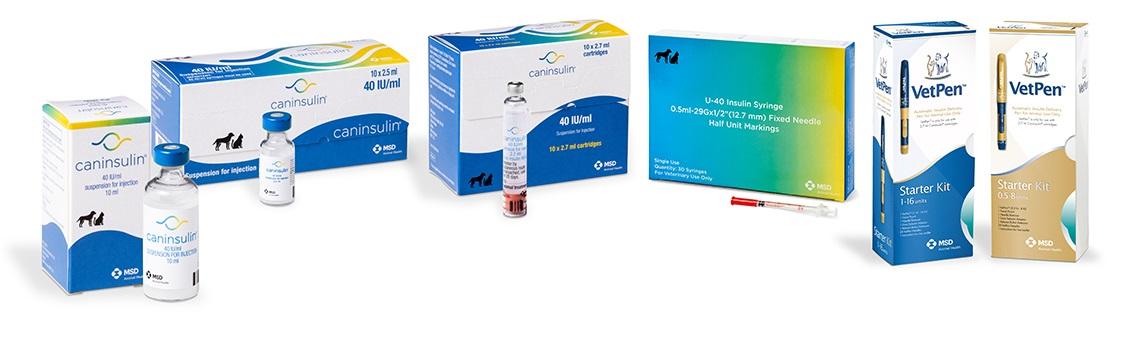
Caninsulin is an intermediate acting insulin product containing porcine insulin, which is structurally identical to canine insulin. Caninsulin can be administered with specific 40 IU sterile single-use syringes (vial) or with a VetPen device (cartridge).
The Pet Diabetes Advisor Course offers six modules to enhance your knowledge of diabetes and help build successful partnerships with pet owners. VetPen training is also provided.
Please visit our diabetes tools for the stabilisation protocol, blood glucose curve generator, personalised client discharge forms and other useful resources including information on diabetes for pet owners.
Presentation
White to almost white suspension for injection.
Active ingredients
Insulin* 40 IU/ml
Target species
Cats, Dogs
Indications for use
It is indicated in cases of diabetes mellitus (insulin deficiency) in dogs and cats, where the required blood levels are achieved by using an individually adjusted dose of the product.
Storage
Before broaching, Caninsulin should be stored upright and refrigerated between +2 to +8°C. After refrigerated Caninsulin is broached, vials and in-use cartridges inside VetPens can be stored at up to 25°C. Broached Caninsulin lasts up to 42 days
Packaging
Caninsulin vial 5 or 10 x 2.5 ml
Caninsulin vial 1 x 10 ml
Caninsulin cartridge 10 x 2.7 ml
Legal category
POM-V
Frequently Asked Questions
General Caninsulin® FAQs
What is Caninsulin?
Caninsulin is a porcine insulin zinc suspension, provided by MSD Animal Health in the U.K. and is available in 10 ml and 2.5 ml vials for injection and 2.7 ml cartridges for use in VetPen®.
Is Caninsulin new?
No – Caninsulin is registered in over 30 countries. First registered in Australia in 1990, the established safety and efficacy profile of Cainsulin is supported by more than 25 years experience.
Does Caninsulin have to stay refrigerated?
Unopened Caninsulin vials and cartridges should be refrigerated (between+2 and +8°C). Once opened, broached Caninsulin vials and cartridges can be stored at up to 25°C. Caninsulin preparations should always be protected from light and never frozen.
Important Note: This revised storage guidance is specific for UK vials with a blue top and cartridges with a silver top which contain metacresol as the preservative.
What type of insulin is Caninsulin?
Caninsulin is an intermediate-acting, lente insulin containing 40 IU per ml of highly purified porcine insulin. As a lente insulin, Caninsulin consists of 35% amorphous Zinc insulin and 65 % crystalline Zinc insulin in a suspension.
Can Caninsulin be diluted?
No – Caninsulin is a stable, balanced mixture of amorphous (soluble) insulin and crystalline insulin. The crystalline part is relatively insoluble, which is why the insulin activity lasts more than a few hours. If Caninsulin is diluted, the balance between amorphous and crystalline parts is no longer 30% and 70%, relatively speaking, and the amount of soluble insulin is increased by the aqueous diluent used. This results in an alteration of the pharmacokinetics of Caninsulin. With a larger aqueous fraction, there would be a relative decrease in the crystalline portion, which is responsible for the second peak of insulin activity. This would mean that diabetic patients receiving Caninsulin could become unstable.
In addition, if Caninsulin is diluted, the stability and sterility of the suspension cannot be guaranteed.
How does Caninsulin differ from human insulin products?
The porcine insulin in Caninsulin has the same amino acid sequence as natural canine insulin, whereas that of biosynthetic human insulins is different3. The similar structure of porcine insulin may provide more effective regulation of blood glucose and decrease the risk of anti-insulin antibody development in dogs. Unlike the dog, anti-insulin antibodies do not appear to be a clinically relevant problem in cats.
How long can Caninsulin be used once opened?
Caninsulin vials and cartridges should be discarded 42 days after they are first broached.
Important Note:This revised broached vial shelf life advice is specific for UK vials with a blue top and cartridges with a silver top which contain metacresol as preservative
How many IU are there per bottle or cartridge?
2.5 ml glass vials: 2.5 ml x 40 IU/ml = 100 IU
10 ml glass vials:
10 ml x 40 IU/ml = 400 IU
2.7 ml cartridge:
2.7 ml x 40 IU/ml = 108 IU
Some diabetic dogs and cats that are well regulated on Caninsulin require periodic increases in their insulin dose. Why does this happen?
It is not unusual for insulin requirements to change with time. This is related to disease progression (e.g. alterations in the sensitivity of issue receptors) or factors such as stress and weight gain (which may increase insulin resistance, especially in cats) and changes in exercise patterns.
One of the key reasons for a perceived reduction in stability may be the development of concurrent diseases such as pancreatitis, pancreatic neoplasia or exocrine pancreatic insufficiency (EPI). On top of this some hormone conditions can affect the efficacy of insulin:
In dogs:
Endogenous or exogenous hormones may reduce the effects of insulin. Medication with progestogens should be discontinued immediately and entire bitches should be spayed.
If animals are being treated with exogenous corticosteroids, alternatives to this treatment should be sought or the dose minimised.
Cushing’s disease (hyperadrenocorticism) leads to an increase in the endogenous production of corticosteroids and has many clinical signs in common with diabetes. Where dogs are not responding as expected to their insulin dose, an ACTH stimulation test should be performed to rule out or help diagnose this condition.
In cats:
Acromegaly, caused by a growth hormone–secreting tumour of the anterior pituitary, may be a secondary factor in cases of uncontrolled diabetes mellitus and this condition should be ruled out during the initial diagnostic work-up.
If crystallisation is seen around the stopper of the vial, is the Caninsulin still suitable for use?
Crystals sometimes form around the stopper of the Caninsulin vial. This is normally minimal and seems to be due to transport or storage of the vial in the refrigerator on its side or top. To keep crystallisation to a minimum, store the Caninsulin vial upright in the refrigerator. However, if a limited amount of crystals do form, Caninsulin is usually fine to use. If you have any concerns about excessive crystal formation around the stopper of Caninsulin vials, please contact your local MSD Animal Health account manager.
What should Caninsulin look like?
Caninsulin is a mixture of two different types of insulin. Normally, after gentle mixing (invert (upend) the bottle several times), Caninsulin will appear uniformly clear to slightly cloudy and should not have lumps or flakes floating in it. If you see clumps or flakes floating in the vial after you have re-suspended the product, do not use it.
Always check on the appearance of the Caninsulin before using it!
Is there any information about the use of Caninsulin in rabbits?
Caninsulin is not licensed for rabbits. For more information on diabetes in rabbits, you can call MSD Animal Health Technical Product Support on 01908 685685.
Caninsulin in Dogs FAQs
How does Caninsulin work in dogs?
A lente (intermediate-acting) form of insulin, Caninsulin contains 30% amorphous insulin for rapid onset of activity, usually peaking 4 hours after injection and lasting 8 hours. The remaining 70% of the formula is crystalline insulin which is absorbed more slowly and peaks around 11 hours after administration. The Caninsulin formula allows for a more continuous utilisation of glucose to support the body’s basic functions. Caninsulin should be administered subcutaneously once or twice daily, as required. Two-thirds of dogs require twice-daily administration for effective glycaemic control4,5.
How does Caninsulin specifically benefit canine patients?
Caninsulin is the first U.K. veterinary licensed insulin for the management of diabetes in dogs which allows once or twice daily dosing for maximum flexibility. Other benefits include:11,12,13
– Rapid glycaemic control – the amorphous fraction activity peaks at around 4 hours post-injection and lasts for 8 hours
– Sustained effect – the crystalline fraction is absorbed slowly, with effects peaking at about 11 hours post-injection
– A duration of action from 14 to 24 hours
– Minimal risk of anti-insulin antibodies – the porcine insulin in Caninsulin is identical to natural canine insulin
– VetPen can be used for simple and accurate dosing
How often does Caninsulin need to be administered to dogs?
In dogs, the initial recommended Caninsulin dose is 0.5 to 1.0 IU/kg, given once or twice daily as appropriate, following assessment via a blood glucose curve. The first dose should be given at the same time as food, or immediately after eating.
Vets should re-evaluate at appropriate intervals and adjust the dose in 10% increments based on clinical signs and glucose curve values until adequate glycaemic control has been attained. Dose changes should not be made more frequently than once every 3 days (ideally after 7 days).
Twice-daily therapy should be initiated if the duration of action of insulin once daily is determined to be inadequate.
If twice-daily treatment is initiated, each of the two doses should be 25% less than the once-daily dose required to attain an acceptable nadir.
The impact on blood glucose peaks may last from 14 to 24 hours, and approximately one-third of dogs with diabetes can achieve successful diabetes management with a single dose of Caninsulin per day5.
Can Caninsulin really be used only once daily in dogs?
Clinical studies have demonstrated that approximately one-third of dogs can be maintained adequately on once-daily doses of Caninsulin. The other two-thirds of dogs will require twice-daily administration of Caninsulin4,5.
How many dogs currently have diabetes?
It is estimated that the incidence of diabetes in dogs is up to 1 in 3006,7.
Caninsulin in Cats FAQs
How does Caninsulin work in cats?
Caninsulin is a lente (intermediate-acting) form of insulin that contains 30% amorphous insulin for rapid onset of activity. In cats, the peak activity following subcutaneous administration of Caninsulin occurs between 4-6 hours (with an average of about 4 hours) and the duration of activity varies between 8 and 12 hours8. Therefore, in cats, Caninsulin is initially administered twice daily rather than once daily.
How Does Caninsulin specifically benefit feline patients?
Caninsulin offers a predictable onset and constant duration of effect in cats.
Peak activity occurs between 4-6 hours (average of 4 hours) post injection
Flexible, easy dosing via vials or VetPen
How often does Caninsulin need to be administered to cats?
In cats, the initial recommended dose is 1 or 2 IU per injection given twice daily. So, unlike dogs where initial dosing is based on the baseline blood glucose concentration, dosing of Caninsulin in the feline is on a per-animal basis. The duration of activity of Caninsulin in the cat is shorter than in the dog, ranging between 8 to 12 hours and peak activity levels occurs between 4-6 (average of about 4) hours8.
How many cats currently have diabetes?
It is estimated that the incidence of diabetes mellitus in cats is 1 in 2009,10.
I have an elderly client with a diabetic cat. Can I pre-load insulin doses into syringes to make treatment easier?
The use of traditional injection techniques via a syringe and needle may be a problematic in this case, as the re-suspension of insulin in such small doses and the effect of prolonged contact with syringe materials is unknown.
Alternatively, the use of VetPen for owners that may experience difficulties, may be a good solution. Once the device is primed (which can be done by anyone), VetPen can be stored at up to 25°C and used daily until a replacement cartridge is needed. VetPen delivers an accurate and consistent dose and is easy to use, removing much of the worry for elderly owners, or those with dexterity issues.
VetPen® General FAQs
What makes VetPen unique?
While insulin pens have commonly been used in the management of human diabetes for some time, VetPen is the only device designed exclusively for use in cats and dogs.
Using the same technology found in human insulin pens, VetPen:
Provides a convenient and easy-to-use solution for the injection of insulin in dogs and cats
Delivers an accurate dose consistently over time, with less chance of error compared to the traditional needle and syringe method1
Provides a better fit to pet owners’ lifestyles—takes fewer steps to prepare doses once primed (air removed from the cartridge) and can be used anywhere
Is VetPen difficult to use?
VetPen is ergonomically designed for easy handling and dosing. Additional adaptors are provided to further assist pet owners with visual or manual dexterity issues.
In a study, close to 97% of pet owners reported that VetPen was easy to use overall2. And more than 97% reported being able to learn how to use VetPen2.
Is VetPen more accurate than using an insulin syringe?
Yes – in a laboratory study, VetPen was shown to be consistently more accurate than syringes for low doses. Even when drawn up by trained lab technicians, study results showed that U-40 syringes delivered at least 20%-25% more insulin than needed for a 1-unit dose1. Unlike syringes, VetPen provides a precise and accurate dose every time, without relying on the user to draw up an accurate dose.
Can VetPen be used with different insulins?
No – VetPen must be used with specially-designed 3 ml cartridges containing 2.7 ml of 40 IU/ml Caninsulin. To avoid damaging the VetPen and dosing errors, cartridges containing other insulin should not be used with VetPen.
Using VetPen FAQs
How does selecting a dose with VetPen differ from drawing up a dose with a syringe?
While the overall injection process is similar, VetPen allows clients to select doses more accurately3. With just the turn of a dial, owners can select the correct dose of insulin, then simply push the release button allowing the VetPen’s internal mechanism to deliver the precise dose each time.
How do owners know when the injection is complete?
To make sure the pet’s dose is injected precisely and accurately, owners need to hold down the release button until the arrow (▶) points to the start line (—) on the dose selector. Then, after waiting for at least 5 seconds, they can remove the needle from the skin. This allows for VetPen’s internal mechanism to optimally deliver the selected dose.
What should the insulin cartridge look like after mixing and priming?
Each cartridge contains 2 glass beads to help with the mixing of Caninsulin before use. The cartridge should be thoroughly shaken before inserting it into the VetPen. After shaking, the insulin should appear uniformly milky. The cartridge should not be used if clumps persist after shaking thoroughly. Owners must not mistake the glass mixing beads for air bubbles, which should be removed during priming.
Is VetPen reusable?
Yes – VetPen contains an insulin cartridge that allows multiple doses to be provided with minimal preparation time. When all the insulin has been used, owners can simply remove the empty cartridge and insert a new one. Owners should be made aware that sterile needles are designed for single use only and should not be reused. Tests show that VetPen lasts for at least 3,000 uses4.
What type of needle is used with VetPen?
VetPen is designed to work optimally with 29 gauge/ 12 mm needles, which are small, thin, triple-sharpened and specially lubricated. This equates to a lower penetration force compared to a traditional needle which should reduce discomfort for the pet. These are the only needles that should be used with VetPen.
Can VetPen needles be reused?
No – as with all sterile needles, they are designed for single use only. A new needle should be used for each injection. Immediately after use, the needle should be removed with the needle remover and safely disposed of.
Can I buy spare parts for my VetPen?
No, parts are not available as taking the VetPen apart may compromise accuracy and functionality.
Does VetPen need to be kept refrigerated when it contains an insulin cartridge?
Before use, Caninsulin cartridges should be stored upright and refrigerated between +2 and +8 °C. But once a cartridge has been installed into the VetPen, the VetPen with the cartridge installed, can be stored at room temperature (up to 25°C) for up to 42 days. Caninsulin cartridges should always be protected from light and should not be frozen.
Important note: This revised storage advice relates only to the UK silver-cap cartridges used for Caninsulin containing the preservative metacresol.
How to take care of VetPen.
To clean VetPen, simply wipe with a damp cloth. Do not immerse it in water.
If an owner dials up too much insulin, could they just unscrew the body of the VetPen and press the release button to set it back to zero?
This is not recommended as the drawn up dose will be under pressure by the plunger and release of the body of the VetPen may lead to a partial dose being expelled as the body and cartridge holder are separated under force, potentially causing damage to the mechanism, or injury to the user.
Do I need to prime the Caninsulin VetPen with each use?
No, once a cartridge is primed upon initial insertion, the process is complete – however the cartridge should be checked for air bubbles at each use.
Troubleshooting VetPen FAQs
What if insulin drips actively from the needle after injection?
This may be a sign that the needle has been removed before the injection was completed. If the VetPen needle is removed from the skin too early, the pet did not receive its full insulin dose.
To make sure the pet receives its full dose, press the release button down fully and hold it until the arrow (▶) points to the start line (—) on the dose selector. Then wait at least 5 seconds before removing the needle from the skin to allow VetPen to deliver the full dose.
What if the dose selector does not return to the start line after testing VetPen?
There are 4 likely causes for this:
1. If the release button is not fully pushed toward the needle, it sometimes prevents the dose from being released completely. Be sure to push the release button down fully during each injection so that the dose selector can rotate back to the start line. Then, wait at least 5 seconds before removing the needle.
2. You may be closing your hand too tightly around the dose selector, which can prevent it from fully rotating back to the start line. Avoid this by holding the VetPen like a pen so that the dose selector can rotate freely after the release button has been completely depressed.
3. The needle could be blocked. Replace the needle on VetPen with a new one. It is important to use a new needle for each injection for hygiene and safety reasons.
4. The cartridge may not have contained enough insulin for the full dose. If the cartridge is empty, replace it with a new one and complete the priming process. For additional information, see the next question.
What if there is not enough insulin in the cartridge to complete an injection?
If there is not enough insulin left in the cartridge to give the pet its full dose, owners are advised to replace the cartridge before injecting. If they suspect only a partial dose has been given, they should not attempt to re-dose, but rather wait and give the cat its usual dose at the next injection.
What if a dose too large for the pet is selected?
If too high a dose has been selected, it is very important not to try to turn the dose selector back to a lower dose. This can damage or break the VetPen. The dose selector is designed to move from low to high numbers but cannot be moved back from high to low numbers. If too high a dose has been selected, release the insulin through the needle into a tissue or swab by pressing the release button. Then select the correct dose.
What if no insulin drips actively or squirts from the needle after priming or preparing for use?
There are 2 likely causes for this:
1. The needle is blocked.
To fix, replace the needle on VetPen with a new one. Remember to use a new needle for each injection. The needle is designed for single use only.
2. The cartridge plunger is stuck. Follow these steps to fix this:
- Take off the needle with a needle remover and unscrew the cartridge holder.
- Slide the release button towards the internal plunger and hold it until the arrow points to the start line.
- Dial 2 units without screwing the device back together.
- Push and hold down the release button until the arrow points to the start line.
- Without rewinding the internal plunger, screw the cartridge holder and the VetPen body back together. This should release the cartridge plunger and expel some of the insulin.
Product images are representations of packaging and may not accurately reflect the current packaging available in the GB marketplace.
Date of preparation: October 2024
Further information is available from the SPC, datasheet or package leaflet.
Advice should be sought from the medicine prescriber.
Prescription decisions are for the person issuing the prescription alone.
Use Medicines Responsibly.